
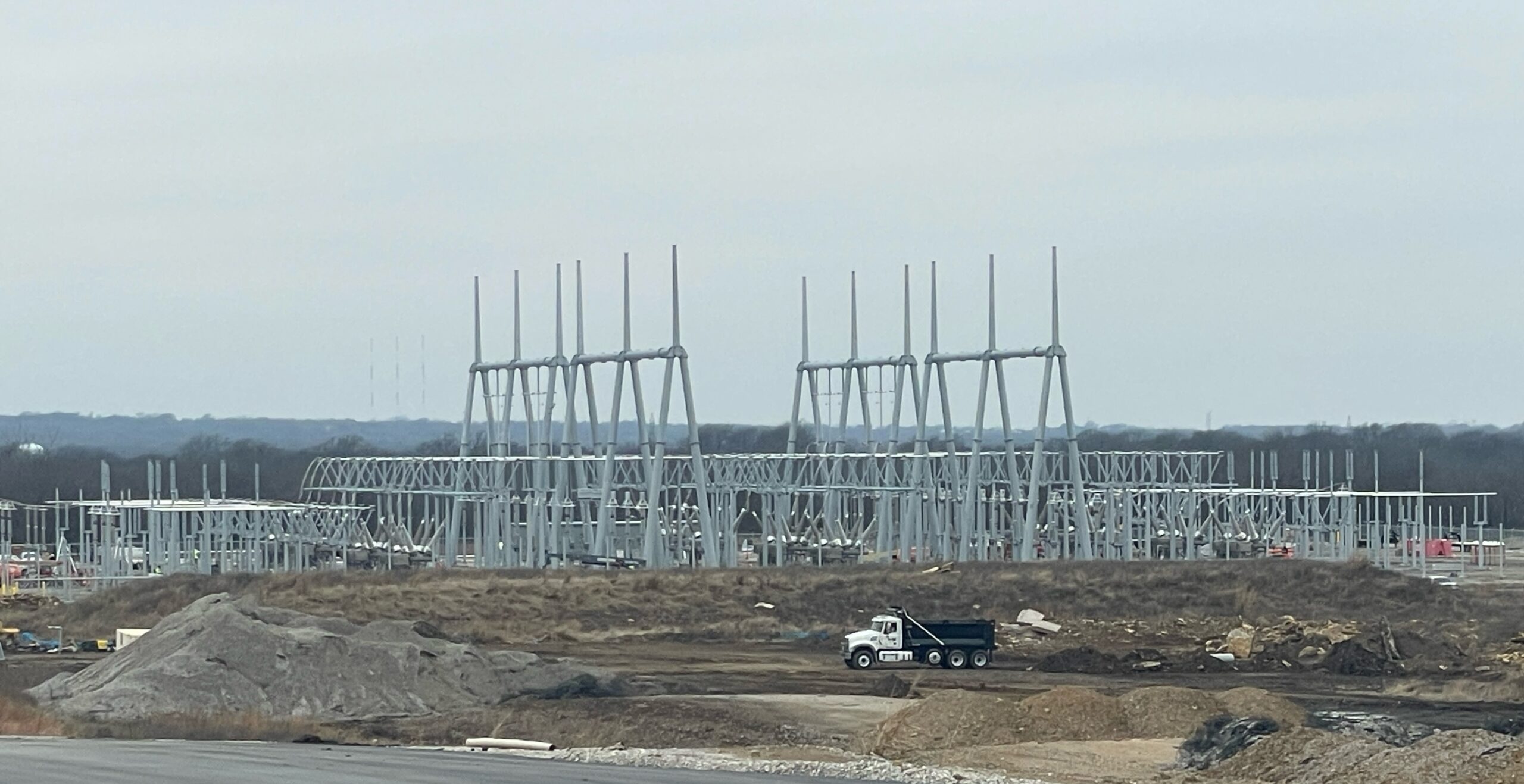
Oklahoma Energy Infrastructure
Data Centers Are Straining Oklahoma's Grid
See the documented load forecasts, utility filings, and current statewide project tracker.
Oklahoma Energy Infrastructure
Data Centers Are Straining Oklahoma's Grid
See the documented load forecasts, utility filings, and current statewide project tracker.
The Scale
Oklahoma's Data Center Boom
Oklahoma's project inventory changes as proposals advance, pause or begin operating. The statewide data-center tracker separates current operating, construction and planned status with source dates.
Public filings show large new loads. PSO signed a single customer agreement for over 1,000 megawatts of power. For context, their previous largest customer contract was 130 MW. That's nearly an 8x jump in a single deal.
PSO has 11 additional contracts, each over 50 MW. The Southwest Power Pool reports 12 large-load customers in queue for Oklahoma as of January 2026.
New: the Oklahoma tracker now includes an interactive state map with resident-report ZIP signals separated from verified project inventory.
MW signed by PSO for one customer
MW in PSO's previous largest customer contract
Large-load customers reported in the SPP queue in January 2026
Your Bill
How This Hits Your Electric Bill
Infrastructure Costs Flow to You
Data centers need massive grid upgrades: new generation capacity, transmission lines and substation expansions. Utilities recover those costs through rate increases on all customers.
Utilities recover approved generation, transmission and substation costs through tariffs and riders. The allocation between large-load and residential customers depends on the final Oklahoma Corporation Commission order.
Review current filings, settlements and approved household impacts.
The Numbers Already Approved
Even before data center costs fully hit, Oklahoma has seen approved rate increases from OG&E ($126.6M) and PSO ($119.5M). The largest rate increases in state history.
Oklahoma electricity rates rose 12.4% year-over-year (EIA data: 11.51 to 12.94 cents/kWh, May 2024 to May 2025).
Open rate cases can change between filing, settlement and final order.
Add to all of this: Winter Storm Uri securitization bonds ($1.4 billion for OG&E + PSO combined) are still being repaid by ratepayers and are being challenged by Oklahoma legislators at the Supreme Court.
Legislative Response
What Oklahoma Is Doing About It
HB 2992
The "Data Center Consumer Ratepayer Protection Act of 2026" is designed to shift more infrastructure costs to large-load data centers instead of residential customers.
SB 1488
Sen. Sacchieri
Proposes a moratorium on new data centers over 100 MW until November 1, 2029. Would pause the growth while Oklahoma figures out the infrastructure question. Not yet law.
Behind the Meter Law
Signed May 2025, effective July 1, 2025
Allows data centers to build on-site power generation rather than relying entirely on the public grid. Could reduce some future grid pressure, but existing contracts remain.
None of these measures are retroactive. Rate increases already approved remain in effect regardless of future legislation.
What You Can Do
Compare Solar Against Future Utility Changes
You can't control OCC rate decisions, data center contracts or legislative timelines. But you can control where your electricity comes from.
Solar can reduce the electricity you buy from a utility, but it does not eliminate fixed charges or make future rates predictable. A proposal should use current utility rules and state any future-rate assumptions.
Payback and financed cost depend on recent usage, modeled production, project cost, loan terms, roof and electrical conditions, and export credits. Review the property-specific estimate and its assumptions.
Start with recent bills
Size from actual consumption
Review production and payback
Check every stated assumption
Compare cash and financing
Use total cost, not payment alone
Grid Independence
Want Backup Power Too?
Solar panels alone won't power your home during a grid outage. They shut off automatically for safety. If you want backup power during outages, you need a battery.
If a later battery is part of the plan, document compatible equipment and electrical requirements during the solar design. Future work and cost depend on the battery, loads and existing installation.
Learn more about battery storage options.
Sources
- The Frontier: Oklahoma's data center boom is about to hit the grid
- SPP: High Impact Large Load Integration
- OCC: Corporation Commissioners affirm interim OG&E rates
- PSO: Approval of rate agreement paves way for grid reliability work
- KGOU: Regulators decline to reconsider OG&E's CWIP case
- U.S. Energy Information Administration: Oklahoma Electricity Profile
- Oklahoma Legislature: HB 2992 (Data Center Consumer Ratepayer Protection Act)
- Oklahoma House: Governor signs HB 2992
- Brockovich Data Center Reporting: U.S. AI Data Center Awareness & Issue Map
- Oklahoma Legislature: SB 1488 (Data center moratorium)
Want to Run the Numbers for Your Home?
We'll compare recent usage, roof potential, current utility rules, project cost and stated rate assumptions.
Get Your Free AnalysisCommon Questions
Frequently Asked Questions
Are data centers causing my electric rates to go up?
Large-load projects can require new generation, transmission and substations. The household effect depends on the tariffs and cost-allocation rules approved by the Oklahoma Corporation Commission. Review the current utility-rate tracker for approved residential impacts.
How much power does a data center use?
A single large data center can consume 100 to over 1,000 megawatts of continuous power. For context, PSO's previous largest customer contract was 130 MW. They recently signed a single data center customer for over 1,000 MW, with 11 additional contracts each over 50 MW.
What is the Behind the Meter law?
Signed in May 2025 and effective July 1, 2025, this Oklahoma law allows data centers to build their own on-site power generation rather than relying entirely on the public grid. While this could reduce some grid pressure, existing data centers and those already contracted with utilities will continue drawing from the shared grid.
Will Oklahoma legislators protect ratepayers from data center costs?
HB 2992 (the "Data Center Consumer Ratepayer Protection Act of 2026") was approved by the governor in May 2026 and is designed to shift more infrastructure costs to large-load data centers. SB 1488 proposed a moratorium on new data centers over 100 MW until November 2029 but did not advance.
How does solar protect me from data center-driven rate increases?
Solar can reduce electricity purchased from the utility, but it does not prevent rate changes or eliminate fixed charges. Compare recent usage, modeled production, utility rules, project cost and stated rate assumptions.
What are the Winter Storm Uri bonds?
After Winter Storm Uri in 2021, OG&E and PSO securitized approximately $1.4 billion in combined storm costs through bonds that ratepayers are repaying over time. These bonds are being challenged by Oklahoma legislators at the Supreme Court as of February 2026. This is a separate cost layered on top of the rate increases and data center infrastructure charges.