

Oklahoma does not have a statewide plug-and-play solar exemption as of August 31, 2026. House Bill 4060 would have created one for qualifying systems up to 1,200 watts, but the bill did not pass the Senate or become law.
That does not make a portable solar panel illegal to own. It means you should not assume you can connect a solar inverter to a standard wall outlet and run it in parallel with the utility without approval. The electrical connection, utility rules, equipment certification and local code still matter.
Is plug-in solar legal in Oklahoma right now?
Oklahoma has not enacted a law that lets a residential customer connect qualifying plug-in solar without utility interconnection approval. HB 4060 passed the Oklahoma House 88-4 on March 24, 2026, then stopped in the Senate Energy Committee. Its proposed November 1 effective date never took effect.
The current answer is narrower than a simple yes or no:
- You can own portable panels, a solar generator or a battery power station.
- You can use a stand-alone system that powers devices without connecting to the home’s utility-backed wiring, if the equipment and use comply with applicable codes and instructions.
- You should not treat a wall-outlet system that runs in parallel with the grid as permit-free or utility-approved in Oklahoma.
- Utility, municipal, cooperative, landlord, homeowners association and local electrical rules can differ by address.
Plug-in solar, portable power and rooftop solar are different
The term “plug-in solar” is easy to misunderstand. A panel with a plug can describe systems that behave very differently.
| System | Where the solar power goes | Connected to utility-backed home wiring? | Typical use |
|---|---|---|---|
| Plug-in or balcony solar | Through a microinverter into a home branch circuit | Yes | Offset small daytime loads |
| Portable panel and power station | Into a battery, then directly to plugged-in devices | No | Camping, temporary power or selected devices |
| Permitted rooftop or ground-mounted solar | Through listed inverters, disconnects, meters and approved interconnection equipment | Yes | Offset a larger share of home or business use |
A power station that charges from portable panels and runs a refrigerator from its own receptacle does not parallel the utility in the same way. A device that sends alternating-current power into a wall outlet does.
That connection is the issue HB 4060 tried to address.
Where the APsystems EZ1 fits
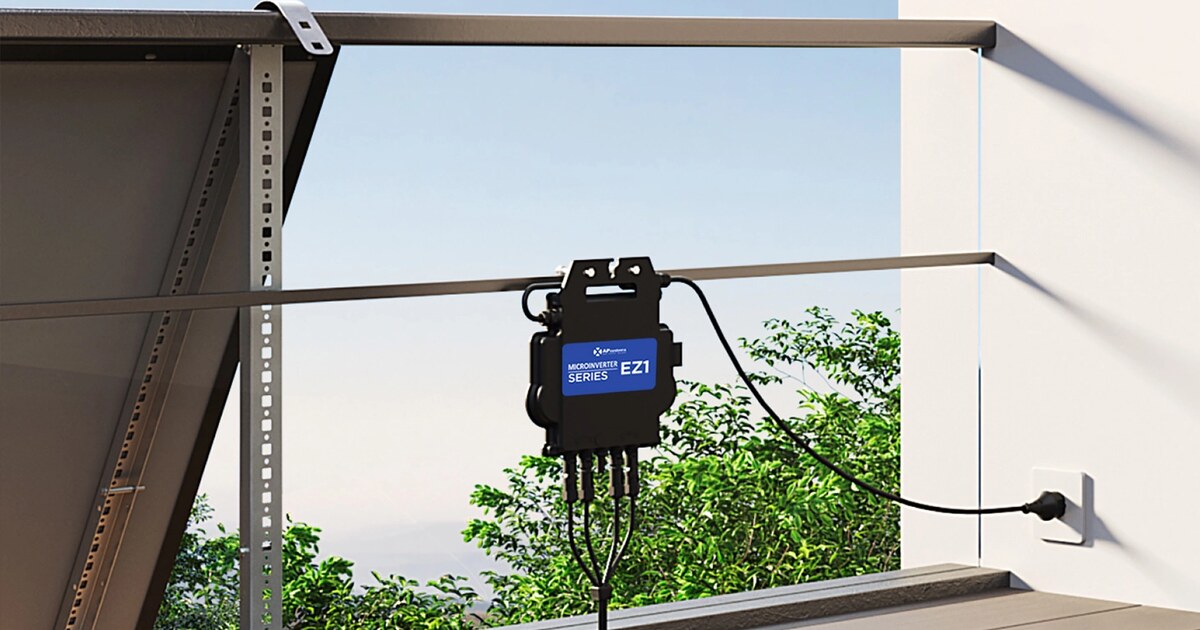
APsystems markets the EZ1 for small panel systems on balconies, patios and other limited spaces.
APsystems says the EZ1 supports two panels, has up to 900 watts of continuous AC output and is CSA certified to UL 3700. The manufacturer also says it meets UL 1741 SB requirements and shuts down automatically when the utility grid fails.
Those product standards do not create an Oklahoma interconnection exemption. The serving utility and local authority still decide what approval is required at a specific address.
What happened to Oklahoma HB 4060?
The official Oklahoma Legislature record shows this timeline:
- February 2, 2026: HB 4060 received its first reading in the House.
- February 11: the House Utilities Committee recommended passage as amended.
- March 4: the Energy and Natural Resources Oversight Committee recommended passage.
- March 24: the House passed the bill 88-4.
- April 1: the Senate referred it to the Energy Committee.
- April 16: the record received its last listed action, adding a coauthor.
The Senate did not pass the measure. A June 2026 policy and safety report from the Southern Alliance for Clean Energy lists Oklahoma’s proposal as deferred until 2027.
That report found plug-in solar legislation had been introduced in 35 states and Washington, D.C. as of June 1, 2026. Nine states had passed a measure by then. Oklahoma was not one of them.
What HB 4060 would have allowed
The engrossed House version of HB 4060 defined a portable solar generation device with four main limits:
- No more than 1,200 watts of rated alternating-current output in total.
- Connection through a standard grounded 120-volt outlet.
- Integrated anti-islanding or equivalent protection that stops the device from energizing the building during an outage.
- Primary use to offset electricity consumed at the customer’s property.
For a qualifying device, the proposal would have removed the normal utility interconnection application, inspection and approval requirements. It also would have barred utility fees, special metering and insurance requirements tied to the device.
The proposal would not have paid customers for exported electricity. It also would not have changed Oklahoma’s existing net-metering programs or the rules for traditional grid-connected solar.
Those details describe a bill that passed one chamber. They are not current Oklahoma law.
Current OG&E and PSO rules still matter
Oklahoma’s investor-owned utilities currently tell customers to obtain approval before connecting customer generation.
OG&E’s customer-owned solar checklist tells customers to review its interconnection guidelines, submit an application, receive approval, pass inspection and wait for Permission to Operate.
PSO’s solar guidance says customers need to submit an interconnection service application before installing distributed generation and connecting it to the grid. PSO’s generating-equipment guidance also says new interconnections must use equipment that meets IEEE 1547-2018 or an equivalent standard. Systems that operate in parallel with its grid are subject to review and approval.
Neither page gives Oklahoma residents a current HB 4060 exemption. A cooperative or municipal utility may use different documents, but the absence of a statewide exemption is the same starting point.
If a seller says its product is “legal in all 50 states,” ask for more than the product listing. Request the written utility rule and local electrical rule that apply to the proposed connection at your address.
A safety label does not replace connection approval
Plug-in solar needs more protection than a normal appliance because power moves in the opposite direction. A branch circuit designed to supply loads can receive power from the utility panel and the solar inverter at the same time.
UL Solutions launched the UL 3700 testing and certification framework in January 2026 for interactive plug-in photovoltaic equipment. Its technical safety overview identifies concerns that include conductor overload, ground-fault circuit interrupter compatibility, user-accessible inverter outputs and energized attachment plugs.
Anti-islanding is one necessary control. It stops the inverter from feeding the home or utility line when grid power fails. Anti-islanding does not answer every question about the outlet, branch circuit, mounting, weather exposure or local code.
Before considering any grid-parallel product, verify all of the following:
- The complete system, not one component, has the required current safety certification.
- The installation follows the product instructions and applicable electrical code.
- The selected branch circuit and receptacle are suitable for the connection.
- The panels and rack can resist wind and cannot block a walkway or exit.
- The utility and local authority have confirmed the required approval path.
- A landlord or association has approved the placement when the property is not solely yours.
Do not use an ordinary extension cord or a homemade male-to-male cord to feed solar power into a receptacle.
How much power could a small system make in Oklahoma?
Panel wattage alone cannot answer that question. Direction, tilt, shade, heat, inverter limits and downtime change production. Patio panels often sit lower and face a less useful direction than a roof array.
Affordable Solar publishes hour-by-hour Oklahoma solar production data from our 7.04 kW system in the Oklahoma City metro. Our 16 panels are rated at 440 watts each and sit in two south-facing arrays with APsystems DS3-L microinverters. The system was commissioned February 24, 2026. On July 27, it produced 42 kWh when rounded to a whole number; the recorded total was 42.38 kWh.
A straight nameplate comparison would assign about 4.8 kWh of that day’s production to 800 watts of capacity or 7.2 kWh to 1,200 watts. That is not a plug-in system forecast. Small patio systems can produce much less because their angle, shade and inverter behavior differ.
Bill value also depends on how much production the home uses immediately. HB 4060 would not have required compensation for exports. Sending unused power to the grid should not be counted as savings unless the serving utility has approved the system and its tariff says how the export is handled.
Use these questions before trusting a savings estimate:
- Which Oklahoma weather data supports the production estimate?
- What direction, tilt and shade does the model assume?
- How much power will the home use while the panels are producing?
- Does the estimate assume payment for exports?
- Which current utility rate values each avoided kilowatt-hour?
The same self-use issue affects larger Oklahoma systems. Our guide to Oklahoma net billing explains why solar used inside the home can be worth more than extra production sent to the grid at an avoided-cost rate.
What can Oklahoma homeowners use now?
You do not need to wait on plug-in legislation to compare solar options. The correct path depends on what you want the equipment to do.
For temporary or selected-device power, consider a listed portable power station that charges from solar panels and supplies devices through its own outlets. Keep the system separate from the home’s utility-backed wiring and follow its capacity, placement and charging limits.
For a cabin, shop or remote load, an off-grid solar system can supply dedicated circuits without operating in parallel with the utility. Off-grid design still requires correct wiring, overcurrent protection, battery planning and code compliance.
For a larger share of home use, compare a permitted Oklahoma solar panel installation designed around the roof, electrical service and serving utility. Add battery storage when outage loads or evening self-use justify the cost.
Until Oklahoma adopts a clear exemption, verify the connection requirements before buying a plug-in kit.