

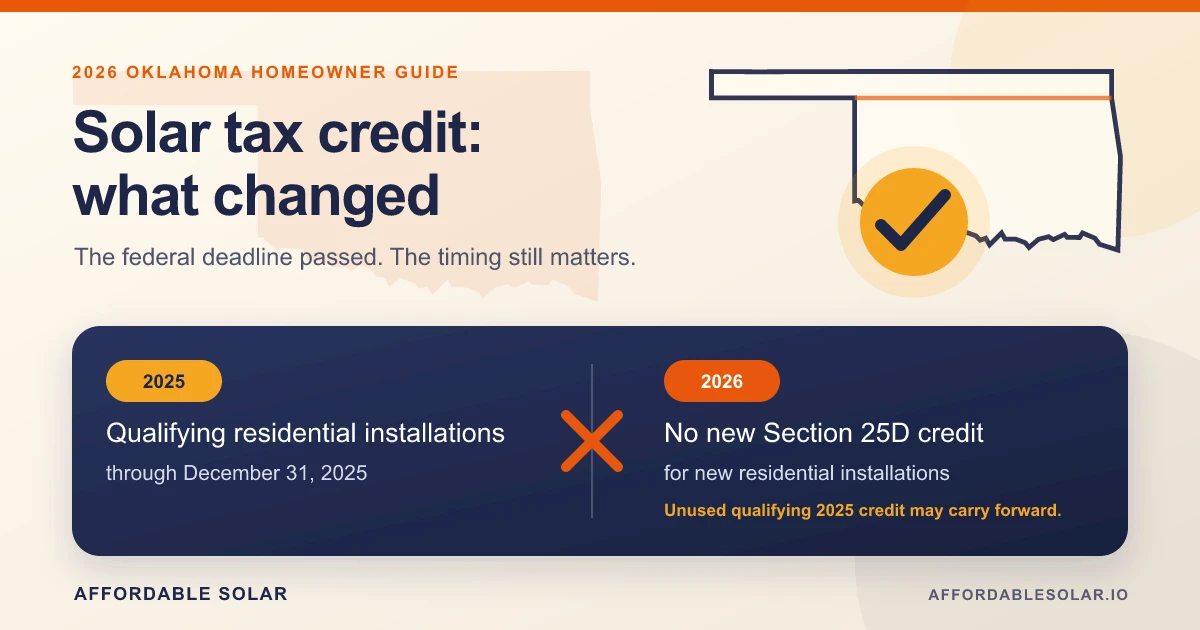
For a new home solar installation in 2026, the federal Section 25D tax credit is no longer available. The same cutoff applies to new residential battery storage. An unused credit from an earlier qualifying project may still carry forward into 2026.
The IRS Residential Clean Energy Credit guidance sets December 31, 2025, as the cutoff. If you’re comparing Oklahoma solar quotes now, start with the full installed price. A new homeowner-owned system should not be priced around a 30% Section 25D credit.
Which solar tax credit can still appear on a 2026 return?
The year you file a return and the year your installation qualifies are different things. A return filed in 2026 can report a qualifying 2025 installation. That does not extend the installation deadline into 2026.
| Your situation | What to check |
|---|---|
| Qualifying installation completed in 2025 | Review eligibility and expenses for the 2025 return. |
| An unused credit remains from a qualifying earlier project | Check the carryforward on Form 5695 with your tax preparer. |
| Deposit paid in 2025, installation completed in 2026 | Payment alone did not preserve Section 25D eligibility. |
| New homeowner-owned solar or battery installed in 2026 | Do not subtract a new Section 25D credit from the price. |
The 2025 Form 5695 instructions explain the carryforward and timing rules. For an existing home, expenditures generally count when original installation is complete. Construction or reconstruction can depend on when you begin using the home. Keep those facts separate from the day you signed a contract.
Utility permission to operate, inspection records, invoices, and the installation agreement can help document a project. None should be substituted automatically for the federal eligibility rule. Ask your tax preparer to resolve a project that spans the deadline.
How an unused credit carries forward
The residential credit is nonrefundable: it can reduce qualifying federal income-tax liability, but the unused amount is not automatically a cash refund. Form 5695 provides for carrying an unused qualifying credit into 2026.
For example, if an eligible earlier project left $2,000 of unused credit, that carryforward belongs to the earlier project. Buying a new battery in 2026 does not create another Section 25D credit. Confirm the amount against your prior return and the applicable filing instructions.
These are homeowner Section 25D rules. A business-owned system or a third-party ownership offer needs a separate review of the owner, contract, and applicable tax provision. A company’s possible tax benefit is not a homeowner credit you can claim.
What removing 30% does to a solar quote
Consider an illustrative $30,000 cash quote for a new 2026 home installation. Subtracting 30% would display a $21,000 net price. Without a qualifying homeowner credit, that leaves a $9,000 gap in the comparison.
| Quote line | Amount |
|---|---|
| Installed cash price in this example | $30,000 |
| New Section 25D credit for a 2026 installation | $0 |
| Price before financing and separately verified incentives | $30,000 |
Roof condition, equipment, electrical work, and battery scope determine the actual price. Our Oklahoma solar cost guide explains those cost inputs.
If a loan assumes you will make a large tax-credit payment later, ask what happens when you do not make that payment. Compare the cash price with the financed principal, fees, interest, term, and total payments. The solar financing guide covers those questions in more detail.
What still affects the bill in Oklahoma
Solar used in your home can reduce electricity purchased from the utility. The value depends on when your home uses power, when the array produces it, and the rate schedule on your account. Fixed charges and electricity purchased at other times can remain.
Exported electricity needs its own calculation. The Oklahoma Corporation Commission’s net-metering explanation distinguishes energy netted against consumption during the billing period from excess production purchased at avoided energy cost.
Get the actual tariff for your service address. OG&E, PSO, electric cooperatives, and municipal utilities should not be treated as one program. Ask which charges solar can offset, how exports are measured, and how credits appear on the bill. Our Oklahoma utility billing guide explains the questions to take to your utility.
Utility efficiency rebates are another separate category. As checked September 7, OG&E’s rebate page says its Oklahoma rebates are closed and will return in 2027. The listed measures include insulation, windows, thermostats, and HVAC equipment. That page should not be used to deduct a rooftop-solar rebate from a quote.
For any proposed incentive, request the program name, official eligibility page, application deadline, available funding, and written explanation of who receives the money.
What a useful 2026 proposal should show
Before comparing monthly payments, ask for:
- The installed cash price and a separate financed price.
- System size in kilowatts and expected annual production in kilowatt-hours, with shading and weather assumptions.
- Expected solar used at home and exported to the grid, valued under your actual utility tariff.
- Battery equipment and installation cost separated from the solar array.
- Included roof work, permits, interconnection, and any electrical-panel upgrades.
- Each incentive identified separately, with eligibility evidence.
- Equipment warranties and the company responsible for installation service.
- Loan terms, total payments, and any assumed future lump-sum payment.
If outage backup is your goal, ask which loads the battery will support and how runtime was estimated. Storage capacity, available power, and transfer equipment determine what works during an outage. The battery storage guide can help you compare that scope.
Bring your electric bill and the complete proposal to a solar project review. Affordable Solar can review the system design, utility assumptions, and installation scope for your Oklahoma address.