

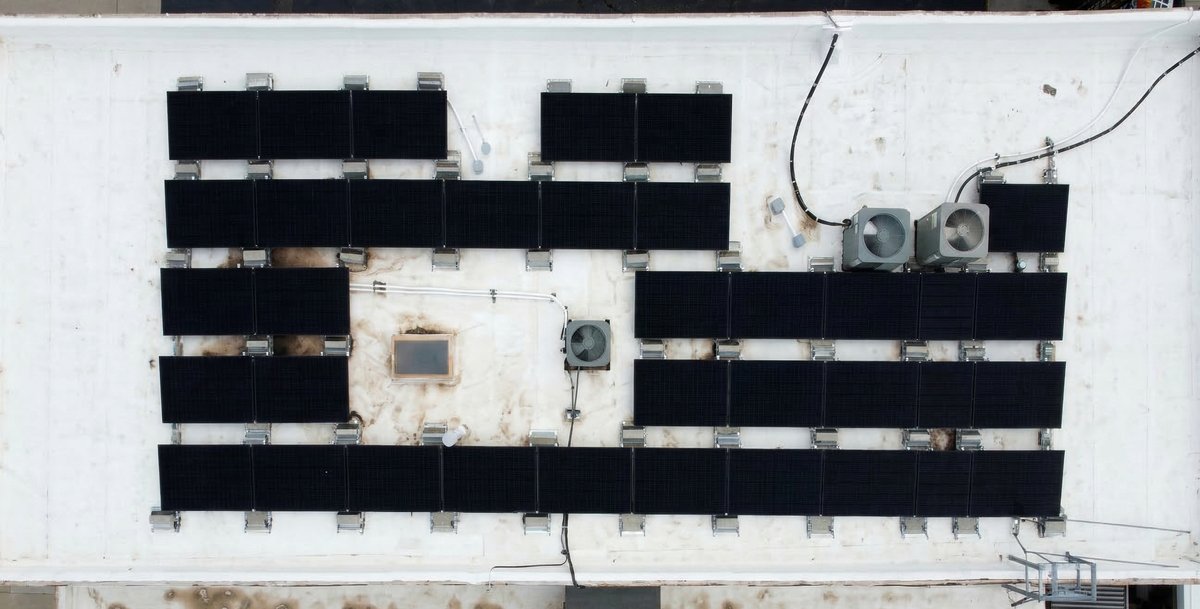
Commercial solar in Oklahoma looks different in 2026 because OG&E, PSO, co-ops, roof conditions, financing costs, and daytime load all affect the same ROI calculation. A large roof is useful. It is not enough by itself.
The question for an Oklahoma business is not “does solar work?” The better question is whether the system matches the way the building uses power.
That means looking past the panel count. A commercial solar proposal should explain annual kWh production, self-consumption, export value, demand charges, interconnection requirements, roof life, lease terms, and the cost of capital. If those pieces are missing, the payback number is not ready to trust.
How Commercial Solar ROI Actually Works
Commercial solar ROI starts with a simple idea: every kWh your business uses from its own solar array is a kWh it does not buy from the utility. That value depends on the rate schedule, riders, time of use, and whether the solar production happens when the building is actually using electricity.
The basic model has two layers:
Commercial solar ROI model
B1 = year 1 net benefit Bn = year n net benefit e = utility escalation d = production degradation
Simple payback is useful because it keeps the first-year claim honest. It answers, “If nothing changes, how many years does the current annual benefit take to recover the project cost?”
But a business should not stop there. The stronger model also includes an escalation-adjusted view, because a solar kWh that offsets a utility purchase in year 10 may be worth more than the same kWh in year 1. With an escalator, payback is not one division. It is a year-by-year cash-flow model. For Oklahoma commercial projects, use 3% annual utility escalation as the base case, then show 0% as a no-escalation stress test and 5% as a higher utility-inflation case.
Annual net benefit should include:
- solar kWh used onsite
- solar kWh exported to the grid
- any demand-charge reduction that is actually supported by interval data
- operations and maintenance assumptions
- financing cost, if the project is financed
- annual utility escalation and solar production degradation in the long-term model
- roof or electrical work that is part of the same decision
That last part matters. A monthly payment is not ROI. A savings chart is not ROI. A proposal has to show how the utility bill changes and why.
For commercial property owners, the most important split is usually self-consumed energy versus exported energy. In Oklahoma net billing structures, exported solar is not always worth the same as electricity used inside the building at the moment it is produced. A system that exports too much can look impressive on annual kWh and still produce weak cash flow.
Why Oklahoma Businesses Need Different Math
Oklahoma electricity has historically been cheaper than many coastal markets. That can make commercial solar harder to sell with a generic national payback claim. It also makes the design work more important.
It also means escalation should be handled carefully. Using EIA’s 2020 Electric Power Annual archive and the February 2026 Electric Power Monthly archive, Oklahoma commercial average retail electricity prices moved from 7.82 cents/kWh in 2020 to 9.08 cents/kWh in 2025. That is about 3.0% annualized. Oklahoma residential prices moved from 10.12 to 13.12 cents/kWh over the same period, about 5.3% annualized. U.S. all-sector prices moved from 10.59 to 13.63 cents/kWh, about 5.2% annualized. That is why the commercial base case should be 3%, with 5% shown as a higher-escalation sensitivity instead of the default.
The strongest commercial fits usually have daytime load:
- offices with weekday HVAC and lighting load
- warehouses with fans, docks, equipment, or refrigeration
- churches and schools with predictable daytime occupancy
- shops with compressors, welders, lifts, or service equipment
- medical, retail, and grocery buildings with steady operating hours
- light-industrial facilities with production load during solar hours
The weaker fits are different. A building with low weekday load, heavy night usage, short lease terms, or a roof that needs replacement in 3 to 5 years may need a very different answer.
Utility territory matters too. OG&E, PSO, OEC, and municipal or co-op utilities handle interconnection, export credits, metering, and billing differently. A commercial proposal in Oklahoma City should not use a generic national model. It should use the actual utility tariff and the business’s usage history.
Code and equipment details matter as well. A real commercial design may need NEC 690 rapid shutdown planning, NEC 705 interconnection review, UL 1741 listed inverters, IEEE 1547 utility-interactive behavior, visible disconnects, production metering, and a racking approach that fits the roof structure. On a low-slope roof, ballast, penetrations, drainage, wind exposure, and roof warranty language all belong in the financial discussion.
Utility Tariff Reality Check: OG&E, PSO, and OEC
The tariff check is where commercial solar ROI gets more specific.
OG&E’s Net Energy Billing Option applies to residential, commercial, industrial, and public authority customers with qualifying systems of 300 kW or less. The tariff also uses a 125% peak-load limit. Excess production is credited at OG&E’s avoided energy cost, based on day-ahead Southwest Power Pool locational marginal prices, not a fixed retail credit. OG&E’s General Service tariff lists a $50.95 monthly customer charge, seasonal energy charges, and Fuel Cost Adjustment language for energy components, including an 8.72 cents/kWh summer line and a 3.65 cents/kWh additional-kWh line.
PSO publishes a separate commercial and small industrial tariff, private generation tariff, and NEBO avoided-energy table. PSO’s General Service Secondary schedule lists a $58.63 customer charge, a $13.46 per billing kW demand charge, and seasonal energy rates that vary by usage block. Its private-generation tariff also uses a 300 kW maximum and a 125% annual peak-demand limit. PSO’s July 23, 2026 NEBO table shows January through June 2026 off-peak avoided-energy prices ranging from $0.0221/kWh to $0.0676/kWh, with later 2026 months calculated after SPP publishes the relevant prices.
OEC is different again. OEC’s non-residential rates show the SMCO2 service availability charge at $1.75 per meter per day, with published on-peak and off-peak commercial energy prices. OEC’s renewable energy FAQ says net metering is available for systems 300 kW and smaller, and systems greater than 125% of the member’s peak load may be excluded from net metering. OEC nets production against usage at retail value during the billing period up to the member’s usage. Monthly production beyond usage is credited at the cooperative’s avoided energy cost. WFEC’s May 2026 Oklahoma avoided cost, which OEC points customers to for current avoided cost, is $0.03151/kWh.
That is why a commercial solar model should have separate rows for OG&E, PSO, OEC, and any municipal or co-op account. The rate schedule can change the result as much as the roof size.
Questions Before Signing
Before signing a commercial solar proposal, ask:
- Will the system pay back before the roof needs work?
- Is the proposal using realistic export-credit assumptions?
- Does the installer survive long enough to service the warranty?
- Is the financing cost hidden inside the monthly payment?
- What happens if permission to operate takes longer than expected?
- Does the model account for fixed charges that remain on the bill?
- Is the business likely to keep the building long enough?
Those are not objections to brush aside. They are the core of the ROI review.
The financing question deserves special attention. A proposal can look better when it focuses on a payment instead of the total project cost. For a business, that is not enough. You need the installed cost per watt, the financing rate, any dealer fee or origination cost, the term length, the assumed utility escalation, and the production model behind the savings.
An Illustrative OKC Commercial Scenario
Consider an illustrative 75 kW roof-mounted system on a warehouse in the Oklahoma City metro.
Assumptions:
- system size: 75 kW
- location type: warehouse in the Oklahoma City metro
- modeled production: 105,000 kWh per year
- production range to test: 95,000 to 115,000 kWh per year
- self-consumption: 70% to 85%
- interval data: 15-minute interval data from the utility account
- equipment class: Enphase, SolarEdge, or equivalent commercial inverters listed to UL 1741
- racking review: IronRidge, Unirac, or equivalent roof attachment planning for structure, wind exposure, drainage, and warranty path
If the building uses 75% of the solar production onsite, then 78,750 kWh is directly offsetting utility purchases. If the business uses an assumed $0.10/kWh avoided value for self-used solar, that portion is worth $7,875 in the first year.
The remaining 26,250 kWh exports. If exported production is valued at $0.03151/kWh, the WFEC May 2026 Oklahoma avoided-cost value that is relevant to OEC excess production, that export portion is worth about $827.
That makes the energy-only first-year value about $8,702 before demand-charge effects, financing, maintenance, utility changes, or accounting treatment.
Simple payback would use that first-year value as the starting point. Escalation-adjusted payback looks at the same value over time. With no utility escalation, $8,702 of annual energy value is $217,550 over 25 years before degradation, O&M, inverter replacements, financing, taxes, or discounting. At 3% annual utility escalation, the same starting value grows to about $317,000 over 25 years. At 5% escalation, it grows to about $415,000.
Those are not savings guarantees. They are sensitivity cases. A finance-ready model should also include panel degradation, an O&M reserve, replacement assumptions for major equipment, tax treatment, and a discount rate. Simple payback tells you when the project crosses zero on today’s dollars. Escalation-adjusted cash flow tells you how sensitive the decision is to future utility prices.
Now change one assumption. If self-consumption drops to 55%, the first-year energy value falls to about $7,264 under the same assumptions. If self-consumption rises to 85%, it rises to about $9,421.
That spread is the point. The same 75 kW system can have different ROI depending on when the building uses power.
For an OG&E account, the exported value should be modeled from OG&E’s avoided-energy-cost method. For a PSO account, it should use the published NEBO avoided-energy table for the relevant production months. For an OEC account, it should separate retail netting up to usage from avoided-cost credit for excess monthly production.
Demand charges can change the result, but only when the data supports it. Solar may reduce some peak demand if the building’s peak lines up with solar production. It may do very little if the peak happens after sunset, during a cloudy interval, or during a short equipment-start event. That is why demand savings should be modeled from interval data, not guessed from the monthly bill total.
Roof, Lease, and Interconnection Risks
Commercial solar is a roof decision as much as an energy decision. If the roof has 4 years of useful life left, a 25-year solar asset creates a timing problem. The owner may need to replace the roof first, build removal and reinstall costs into the model, or choose a different site plan.
Lease structure can matter just as much. A tenant who pays the electric bill but does not own the roof may not be the right buyer unless the landlord and tenant can align incentives. A landlord who owns the roof but does not pay the utility bill may need a lease amendment, power purchase structure, or rent strategy before the numbers make sense.
Interconnection also belongs in the timeline. A commercial project can require more review than a small residential system. Utility application, engineering review, equipment availability, inspection, meter changes, and permission to operate can affect when the system starts producing value.
Ask whether the design is being reviewed under the correct utility process. Ask which party owns interconnection paperwork. Ask what happens if the utility requires equipment changes, meter work, or a different protection scheme.
What to Ask Before You Buy
Before approving a commercial solar proposal in Oklahoma, ask for the numbers behind the number.
Start with usage:
- Did you review 12 months of utility bills?
- Did you review 15-minute interval data?
- What is the building’s weekday daytime load?
- What percent of production is expected to be used onsite?
- What percent is expected to export?
Then ask about the utility model:
- Which OG&E, PSO, OEC, co-op, or municipal tariff did you use?
- What value did you assign to self-used kWh?
- What value did you assign to exported kWh?
- Did you use OG&E avoided energy cost, PSO’s NEBO table, OEC retail netting, or a co-op avoided-cost value?
- Are fixed monthly charges still shown?
- Are demand charges modeled separately from energy charges?
Then pressure-test the project scope:
- What is the installed cost per watt?
- Does the quote include structural review?
- Does it include roof attachment or ballast details?
- Does it include electrical upgrades?
- Which NEC 690 and NEC 705 requirements affect this design?
- Are the inverters UL 1741 and utility-approved?
- Does a NABCEP professional, Enphase certified designer, SolarEdge trained designer, or IronRidge certified racking specialist review the final plan?
- Who handles permitting, inspection, and permission to operate?
Finally, ask about business risk:
- How long do you expect to own or lease the building?
- What is the roof’s remaining life?
- What happens if the original installer is unavailable later?
- What workmanship warranty covers labor and roof penetrations?
- How is monitoring handled after commissioning?
- What assumptions would make the payback longer?
That final question is the one worth asking twice. A serious proposal should be able to show what breaks the math.
The Bottom Line
Commercial solar can make sense in Oklahoma, but it is not automatic. The best candidates have strong daytime load, a roof with enough remaining life, clear utility assumptions, realistic self-consumption, and a business horizon long enough to benefit from the asset.
The weak proposals skip those details. They show a big system, a clean monthly payment, and a payback number without proving the inputs.
For an Oklahoma business, the right solar proposal should make the tradeoff sharper, not smoother. It should show how much power the system produces, how much the building uses onsite, how much exports, what remains on the bill, and which assumptions carry the most risk.
If the ROI still works after that review, the project is worth a serious look. If it only works when the model hides roof timing, export value, financing cost, or demand-charge uncertainty, the business has not bought an energy asset yet. It has bought a spreadsheet.
For a project-specific review, see how Affordable Solar plans commercial solar installation in Oklahoma around facility load, roof condition, and utility interconnection.